Cumberland Country Golf Club stands proud as one of the most innovative, expansive and far sighted establishments in the NSW golf fraternity.
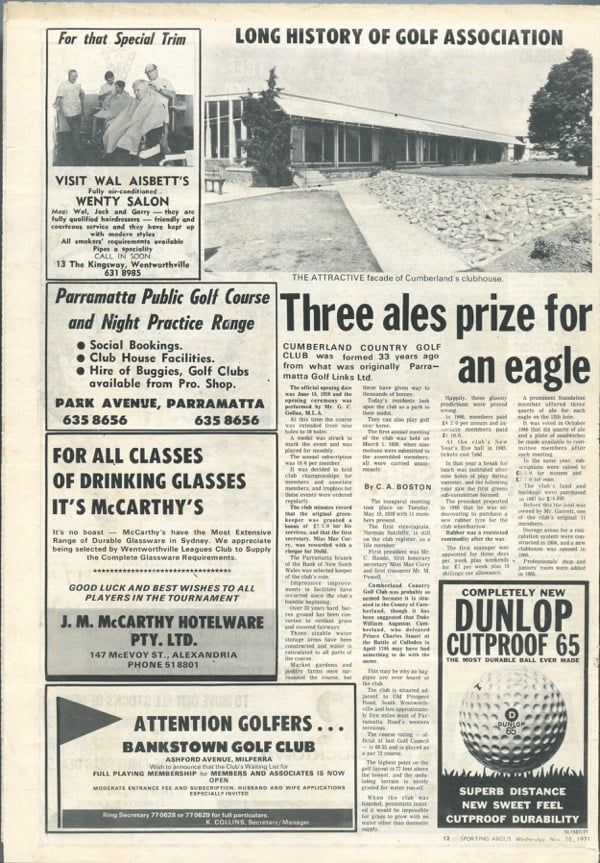
Golf was actually played on the existing site two years before the birth of the Cumberland Country Golf Club. Way back in 1935 a nine hole course, the forerunner to today’s magnificent 18 hole layout was in operation. It was known as Parramatta Golf Links and was privately owned by a Hunters Hill investor.
In 1937 a circular was distributed around the area on the clubs formation and request for membership. The rush for membership was intense and the course was soon developed into an 18 hole layout and on 24 September 1937 Cumberland Country Club came into being and was officially opened on 18 June 1938 by Mr G.C. Gollan, MLA.
The land was purchased from the Hunter’s Hill investor by a foundation member for £3000 and the Clubs first annual General meeting was held on 1 March 1939 where nine motions were submitted to the assembled members and carried unanimously. The Club was incorporated as a company the following year. On 13 June 1940 the Club became known as Cumberland Country Golf Club Ltd.
Building the Course
The Club’s early years were challenging. World War II had commenced, water was scarce apart from the domestic supply, fairways consisted largely of ironstone and even golf balls were in short supply.
A significant step towards developing Cumberland into the highly regarded golf course it would become was the decision to purchase the land, buildings and improvements in 1947 for £14,450.
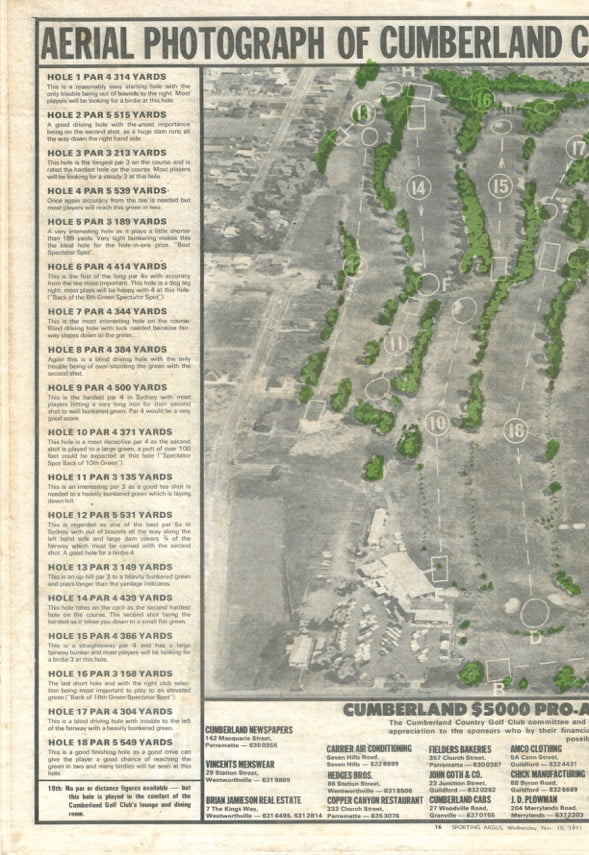
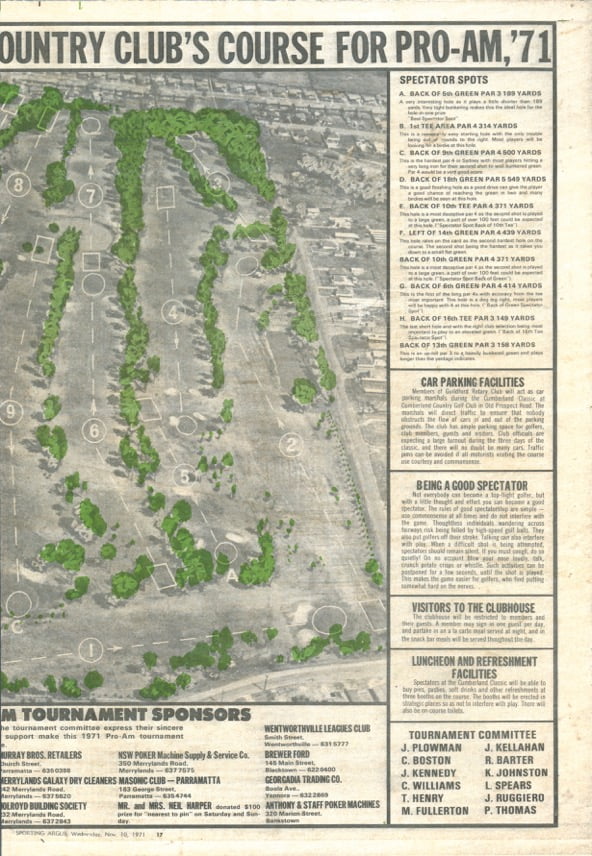
Further investment followed in course maintenance and improvements, and the Club employed its first greenkeeper in 1949. During the early 1950s, the course improved dramatically through fairway grassing, construction of new tees and extensive tree planting.
In the latter part of the decade, new dams were constructed and the Club’s first fairway watering system was installed at a cost of £7,000. Even greens from the former Roselands Golf Course found a new home at Cumberland.
The course continued to improve throughout the 1960s. Cumberland also demonstrated an innovative approach to course care and member responsibility, becoming an early adopter of the simple sand bucket as a compulsory accessory for members on the course — something now commonplace throughout Australian golf.
In 1981, the Club purchased a new automatic watering system, followed in 1998 by the installation of a fully computer-controlled fairway irrigation system.
Securing Cumberland’s Future
Cumberland continued its tradition of innovation by investing in the long-term security of its most important natural resource — water.
A major pipeline project was undertaken to capture water runoff from a nearby catchment more than four times the area of the golf course itself. This valuable water resource has helped maintain the healthy and attractive playing surfaces enjoyed by members and visitors.
In 2015, further investment was made when the Club converted the 12th-hole dam to fresh water storage and installed a secondary irrigation system dedicated to servicing greens and tees.
These initiatives placed Cumberland in an enviable position to maintain quality playing surfaces through Sydney’s demanding summer conditions while substantially improving the Club’s long-term water security.
A New Era for Cumberland
In 2017, Cumberland began exploring what would become the most ambitious transformation in the Club’s history.
Rather than simply maintaining an ageing golf and clubhouse facility, the Club embarked on a long-term masterplanning process designed to secure Cumberland’s financial sustainability, modernise its facilities and ensure that golf remained at the centre of the property for generations to come.
The resulting masterplan brought together the redevelopment of the golf course, a new clubhouse and associated facilities, together with a broader development strategy intended to unlock the value of the Club’s substantial landholding while protecting its future as a golf club.
After years of planning, consultation, design and approvals, the vision began moving from the drawing board to reality.
A significant component of the masterplan involved the redesign and realignment of the golf course to accommodate the future development while creating a modern, challenging and sustainable 18-hole layout.
The project represented far more than simply relocating several holes. It provided an opportunity to reconsider how the golf course flowed across the property, improve playing strategy and presentation, modernise infrastructure and ensure the course could operate successfully alongside the future development.
Construction involved significant earthworks, new greens and tees, bunker and fairway works, pathways, drainage, irrigation, landscaping and the establishment of new playing corridors.
Throughout the project, the Club continued operating as a functioning golf club — requiring careful staging of works and considerable patience from members as the course progressively changed around them.
The New Cumberland Course
A defining moment in Cumberland’s history arrived on 4 July 2026, when the Club officially opened its new 18-hole course layout.
The opening represented the culmination of years of planning and construction and marked the beginning of an entirely new chapter for Cumberland Country Golf Club.
The redesigned course retained the character and history of Cumberland while introducing a new playing experience created for the future of the Club.
Importantly, the opening of the new layout was not the completion of the masterplan, but a major milestone within a much larger transformation.
Further course works and improvements continue as the broader development progresses, ensuring that the golf course evolves alongside the new facilities being created around it.
The Next Chapter
Cumberland is now undertaking a transformation on a scale rarely seen in Australian club golf.
The wider masterplan includes a new clubhouse and associated member facilities, together with the broader development of the Club’s property in partnership with its development partners.
The new clubhouse will provide a contemporary home for Cumberland’s members and guests, overlooking and connecting with the golf course while providing modern hospitality, administration, golf and community facilities.
The broader development is designed to create a sustainable long-term financial foundation for the Club while allowing Cumberland to retain its identity, heritage and commitment to golf.
It represents the continuation of a philosophy that has existed throughout Cumberland’s history: invest today to protect the Club for tomorrow.
From purchasing its land in the 1940s, to installing irrigation when water security became critical, to continually improving the golf course and now undertaking a generational redevelopment of the entire property, Cumberland has repeatedly demonstrated a willingness to look beyond the immediate future.
What began as a privately owned nine-hole golf course in 1935 has grown into a Club approaching its centenary with a completely renewed golf course, a new clubhouse and facilities on the way, and a long-term development strategy designed to secure Cumberland Country Golf Club for generations to come.
The surroundings may continue to change, but the purpose remains much the same as it was when the Club was founded in 1937:
to provide an outstanding golf club for its members, guests and community — and to leave Cumberland stronger for the generations that follow.